

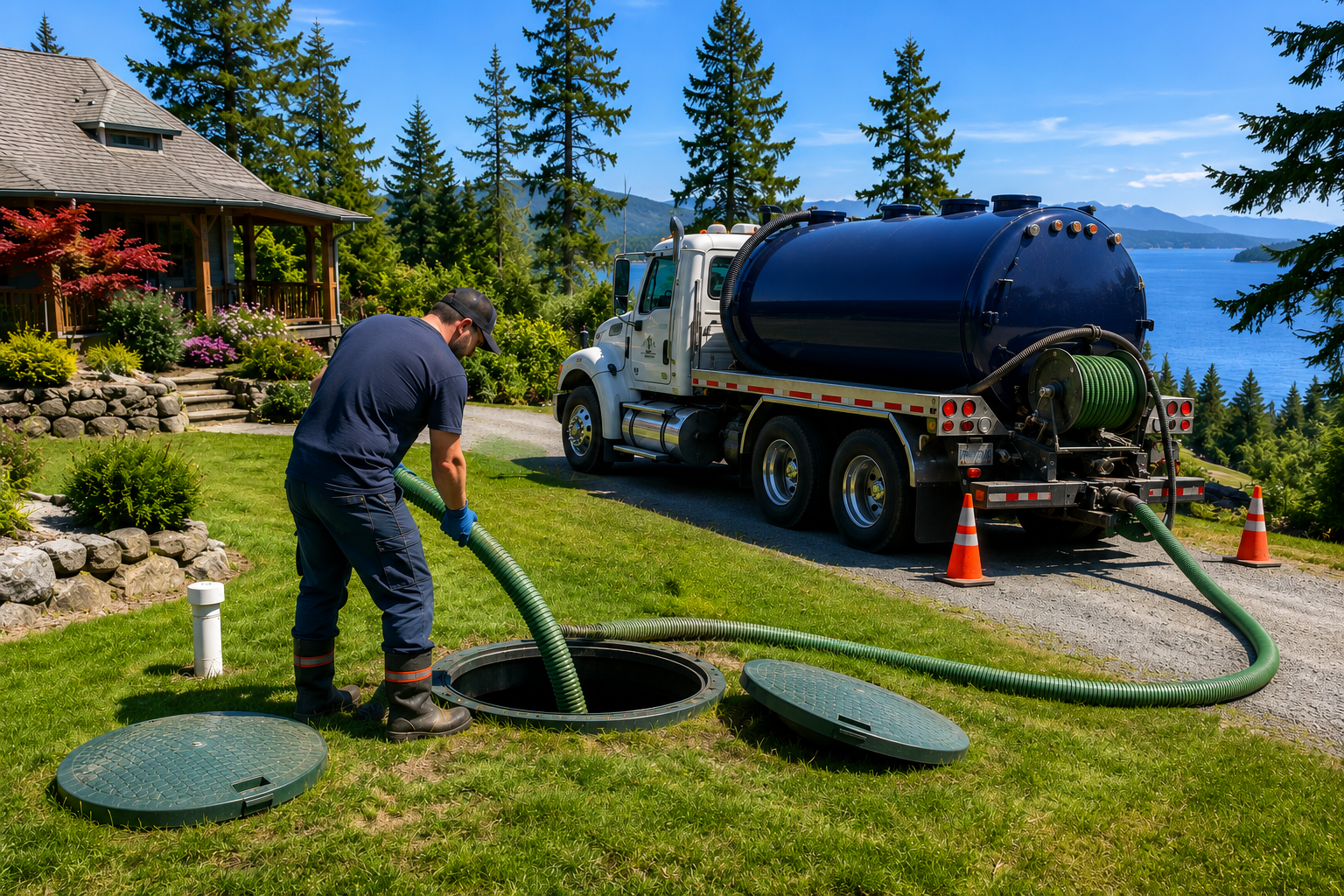
Summer on Vancouver Island means longer days, visiting family, and a house that suddenly has a lot more people in it. It is a great time of year. It is also, for anyone on a septic system, the time of year when that system gets pushed the hardest. More guests, more laundry, more showers, and more dishes all add up to a heavier load than your septic tank sees the rest of the year.
That is why a common question lands in our inbox every spring: should I pump my septic tank before summer? The honest answer is, it depends, but there is a clear way to figure out whether the answer for your home is yes. Here is how to decide, and why timing it before summer can save you from the worst possible moment for a backup.
Why summer is hard on septic systems
Your septic tank is sized for the normal daily water use of your household. Through most of the year, that balance holds. The tank does its job, solids settle, liquid moves out to the drain field, and the system stays in rhythm.
Summer breaks the rhythm. When you have guests staying, the household water use can climb dramatically. More toilet flushes, more showers, more loads of laundry, and more dishwashing all flow into the same tank. If the tank is already fairly full of accumulated solids, that surge of extra use can be the thing that tips it over from coping to backing up.
And here is the unfortunate timing: the busiest weekends, with the house full of people, are exactly when you least want a septic failure. A backup over a long weekend with guests in the house is about the worst-case scenario, and it is also one of the most preventable.
How to know if your tank needs pumping
Pumping is not something you do on a whim, and it is not something you do too often either. The right answer comes down to a few practical factors.
How long has it been?
The most important factor is simply time. Most household septic tanks need pumping every few years, with the exact interval depending on tank size and how many people use the system. If it has been several years since your last pump-out, you are likely due, and pre-summer is a smart time to take care of it. If you genuinely cannot remember when it was last pumped, that itself is a strong sign it is time.
How big is your household, and how big is the tank?
A larger household fills a tank faster, and a smaller tank fills faster than a larger one. A big family on a modest tank may need pumping more often than the average interval, while a couple on a generously sized tank can go longer. If your normal household is already on the larger side and you are about to add summer guests, the case for pumping before the season gets stronger.
Are you expecting a busy summer?
This is the summer-specific piece. If you are hosting extended family, running a busy household of visitors, or simply expecting a much higher level of use than normal for a stretch of the season, pumping beforehand gives your system maximum capacity to handle the surge. Going into a high-use summer with a tank that is already two-thirds full of solids is asking for trouble.
Any warning signs already?
If your system is already showing early signs of strain—slow drains, occasional gurgling, faint odours, or any history of backups—do not wait for summer to test it further. Those signals mean the system has little margin left, and the extra summer load could push it over. Pump first, and have it assessed if the signs persist after.
The case for pumping before summer specifically
Even if you are only roughly due, there is a good argument for timing the pump-out before the busy season rather than after. A few reasons stand out:
- You go into the high-use months with full capacity, giving your system the best chance of handling guests without strain.
- You avoid a backup at the worst possible time, when the house is full and a failure is most disruptive.
- Spring and early summer are easier conditions for the work than the wet months, with better access to the tank and surrounding ground.
- You get peace of mind for the whole season, instead of quietly worrying every time the laundry and showers pile up.
Pumping is a routine, affordable bit of maintenance compared to the cost and disruption of an emergency backup. Doing it on your own schedule, before the pressure is on, is simply the smarter play.
What pumping does and does not fix
It is worth being clear about what a pump-out actually accomplishes. Pumping removes the accumulated solids from your tank, restoring its working capacity so it can handle incoming wastewater the way it is meant to. That is exactly what you want going into a high-use stretch.
What pumping does not do is fix a failing drain field or a deeper structural problem. If your system is struggling because the ground is saturated from previous seasons (which we cover in our guide on how wet coastal weather affects septic systems on Central Vancouver Island), a pump-out helps in the short term but does not solve the root environmental issue. That is why, if your system has been showing persistent problems, it is worth having it properly assessed rather than relying on pumping alone to carry it through. A good septic professional will tell you honestly which situation you are in.
Simple habits to protect your system through summer
Pumping aside, a few easy habits help your septic system handle a busy summer:
- Spread out heavy water use. Avoid running every load of laundry on the same day when the house is full. Spacing it out gives the system time to keep up.
- Be mindful of what goes down the drain. Wipes, grease, and other items that do not break down add to the solids load and can cause clogs.
- Give guests a gentle heads-up that the home is on septic, so they know to be reasonable about water use and what gets flushed.
- Keep an eye out for early warning signs through the season, and act on them quickly rather than hoping they pass.
Frequently asked questions
How often should a septic tank be pumped?
Most household tanks need pumping every few years, with the exact interval depending on tank size and household size. A larger household or smaller tank means more frequent pumping. If it has been several years or you cannot remember the last time, you are likely due. You can view our baseline options directly on our Vireel septic pumping service page.
Will summer guests really overload my septic system?
They can, especially if the tank is already fairly full of solids. A house full of guests means far more water use than normal, and that surge is often what tips a marginal system into a backup. Pumping beforehand reduces that risk.
Is it better to pump before or after summer?
Before, in most cases. Pumping ahead of the busy season gives your system full capacity when it needs it most and helps you avoid a backup at the worst possible time. It is the proactive choice.
Does pumping fix a septic system that keeps backing up?
Only if the problem is a full tank. Pumping restores capacity, but it will not fix a failing or saturated drain field. If backups keep happening, have the system properly assessed to find the real cause.
The bottom line
If it has been a few years since your last pump-out, your household is on the larger side, or you are expecting a busy summer of guests, pumping your septic tank before the season is a smart, low-cost piece of maintenance. It gives your system full capacity for the heaviest-use months and spares you a backup at the very worst time.
Not sure whether you are due? Vireel can take a look, give you a straight answer, and handle the pump-out on a schedule that works for you. Head over to our contact or book a service page to reach out before the summer rush, and head into the season with one less thing to worry about.