

The drain field is the part of your septic system doing the quiet, unglamorous work of treating wastewater after it leaves the tank. Most homeowners never think about it until something goes wrong, and by the time something goes wrong loudly—backed up drains, sewage smell, standing water in the yard—the field has usually been struggling for a while already. Catching the early signs saves both money and a genuinely unpleasant mess.
What the drain field actually does
After wastewater is partially treated in the septic tank, it flows out into the drain field, a network of perforated pipes buried in gravel trenches. From there it slowly filters down through the soil, which does the final stage of natural treatment before the water rejoins the groundwater. When the field is working properly, this process is invisible. You would never know it was there.
A drain field fails when it can no longer absorb water at the rate your household is sending it down the drain, whether from age, soil saturation, root intrusion, or a system that was undersized for the property to begin with.
Early signs that are easy to miss
Slow drains throughout the house, not just one A single slow drain is usually a local clog. When multiple drains across the house—kitchen, bathroom, laundry—all start draining sluggishly around the same time, that is a system-level sign, not a fixture-level one.
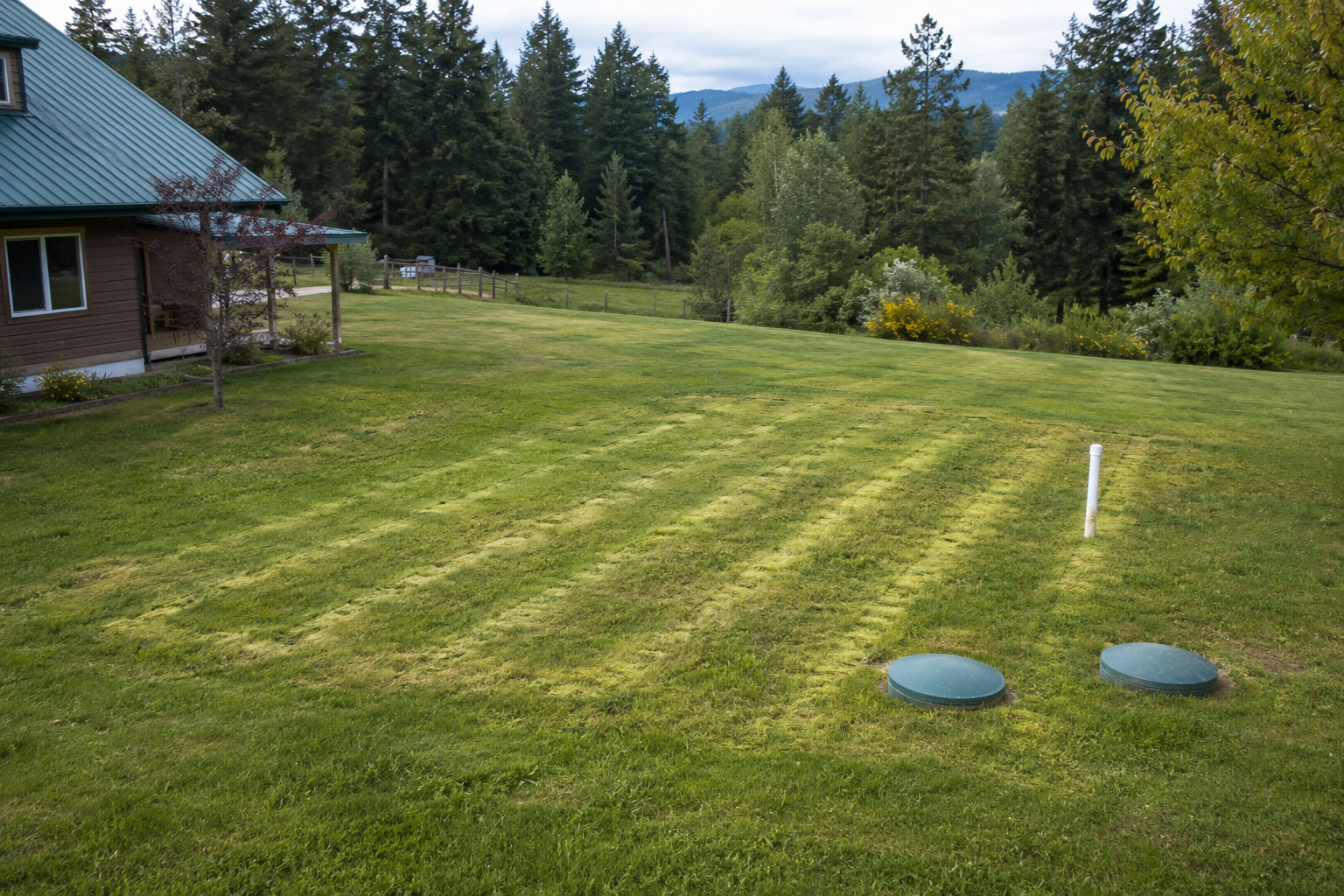
Unusually green or lush grass over the field A patch of grass that is noticeably greener and grows faster than the rest of the lawn, tracing the shape of the field lines, often means effluent is surfacing close enough to the roots to act as fertilizer. It looks harmless. It is not.
Soft or spongy ground over the field area Ground that feels wet or gives underfoot even during a dry spell is a sign the soil is not absorbing water the way it should.
Sewage odor outdoors, especially after rain A faint smell near the field after heavy rain can be normal in small doses. A persistent or strong smell, particularly on dry days, usually is not.
Signs that mean the problem has progressed
- Standing water or visible pooling over the drain field
- Sewage backing up into tubs, toilets, or floor drains
- Gurgling sounds from drains or toilets after flushing
- Alarm activation if your system has an effluent pump with a warning float
- Sewage odor inside the house that was not there before
Why waiting makes it worse, not better
A struggling drain field does not fix itself with time. Left alone, saturated soil stays saturated, and the biological mat that clogs the trenches thickens rather than clearing. What starts as slow drains and a soggy patch of lawn can progress to sewage backing up inside the home, contamination of nearby groundwater or waterways, and in the more advanced cases, full replacement of the drain field rather than a repair. On a lot with limited space or challenging soil, which describes a fair number of Vancouver Island properties, a full field replacement is a significantly bigger and more expensive job than addressing the early warning signs would have been.
What can often be done before it reaches that point
Not every failing symptom means the field needs to be dug up and replaced. Depending on what is found, options can include pumping the tank to relieve pressure on the field, resting part of the system to let the soil recover, addressing a specific blockage or root intrusion in one section of pipe, or in some cases restoring drainage in an aging field rather than replacing it outright. The right answer depends on an actual inspection, not guesswork, which is exactly why catching the early signs and calling before things escalate matters so much.
How soil type on your property affects the picture
Not all Vancouver Island properties are working with the same soil, and that matters for how a drain field behaves and how much warning you get before problems become serious. Sandy or well-draining soil tends to absorb water efficiently and can mask early warning signs a bit longer, since the ground does not pool as readily even when the system is under stress. Denser clay soil, common in parts of Central Vancouver Island, drains slowly to begin with, which means a struggling field shows symptoms—standing water, soft ground—sooner and more visibly, but also means the underlying soil had less absorption capacity to work with from the start. Knowing which type of soil your property sits on helps set realistic expectations for how your specific system is likely to behave as it ages.
What tends to shorten a drain field’s life on the Island
- Heavy water use concentrated into short bursts—back-to-back laundry loads, for example
- Vehicles or heavy equipment driven or parked over the field, compacting the soil
- Trees or large shrubs planted too close, with roots seeking out the moisture
- Skipping regular tank pumping, which lets solids carry over into the field
- A field that was undersized for the property or household from the start
How a professional assessment actually works
When a drain field is suspected of failing, an inspection typically starts with a visual assessment of the field area, checking for pooling, unusual grass growth, and soft ground, followed by a check of the tank itself to rule out a full tank mimicking field symptoms. In some cases a dye test or hydraulic load test is used to see how the system actually handles water under real conditions, which gives a clearer picture than a visual inspection alone. Depending on what is found, the next step ranges from simple maintenance, like pumping and resting the field, through to a more involved repair or, in more advanced cases, a plan for partial or full replacement.
The point of this step-by-step approach is that a proper diagnosis avoids paying for a bigger fix than the problem actually calls for. Jumping straight to replacement without confirming the tank and field are both actually the source of the issue is how homeowners sometimes end up spending more than necessary.
Protecting a healthy drain field going forward
For a system that is currently working well, a few habits go a long way toward keeping it that way. Spreading laundry loads and heavy water use throughout the week rather than concentrating them into a single day reduces peak load on the field. Being mindful of what goes down the drain, avoiding grease, harsh chemicals, and anything non-biodegradable, protects the biological processes both the tank and the field depend on. Keeping vehicles, sheds, and heavy equipment off the field area preserves the soil structure the system needs to function. None of these habits are complicated, but consistency matters more than any single action.
Frequently asked questions
How often should the septic tank be pumped to protect the drain field? Most residential systems need pumping every three to five years, though household size and usage patterns can shift that timeline. Regular pumping is one of the simplest ways to protect the field from premature failure.
Can a failing drain field be repaired instead of replaced? In many cases, yes, particularly if the problem is caught early. Replacement typically becomes necessary when the soil itself has become too saturated or compacted to function, which usually happens after the earlier warning signs have been ignored for some time.
Is it safe to plant a garden over a drain field? Grass and shallow-rooted groundcover are generally fine. Trees, shrubs, and vegetable gardens are not recommended, since roots seek out moisture and can damage the pipes, and heavier digging can compact the soil.
How do I know if it is the tank or the field causing the problem? This usually requires an inspection to determine. A full tank can sometimes mimic early field symptoms, which is one reason a professional assessment is worth getting before assuming the worst.
How long does a properly maintained drain field typically last? With regular pumping and reasonable use, a well-designed and properly installed drain field can last several decades. Systems that are neglected or overloaded can fail in a fraction of that time.
Is it normal for a drain field to need replacement eventually even with good care? Yes, all drain fields have a finite lifespan as the soil’s absorption capacity gradually diminishes over many years of use, even with excellent maintenance. Good care extends that lifespan significantly rather than preventing eventual replacement altogether.
If you are noticing any of the early signs above, Vireel can inspect the system and give you a straight answer on what is actually going on, before it turns into a bigger job than it needs to be.