

It is one of the first questions anyone asks when they find out their new build or renovation needs a septic system, and it is also one of the hardest to answer with a single number. Ask five different homeowners what they paid and you will get five different answers, and all of them can be correct, because the cost of a septic system depends almost entirely on the property it is going into.
That said, there are real ranges and real cost drivers, and understanding them before you start planning saves you from either sticker shock or a budget that was never realistic to begin with. Here is what actually moves the price.
The Baseline: What a Standard System Runs
For a straightforward conventional gravity septic system on a property with decent soil and reasonable access, a typical Vancouver Island installation lands somewhere in the range of fifteen to thirty thousand dollars, all in. That figure covers design, permitting, excavation, the tank itself, the drain field, and backfill.
That is a wide range for a reason. A small system for a modest cabin on flat, sandy soil sits at the low end. A larger home needing a bigger tank, on a property with any complications at all, climbs quickly toward the top of that range and sometimes past it. Nobody can give you an accurate number without seeing the site, but that range at least tells you what ballpark you are budgeting in.
Soil Conditions Are the Single Biggest Factor
More than anything else, what is in the ground determines what the system costs. Sandy, well-draining soil is the easiest and cheapest scenario, since a conventional gravity system can usually handle it without much extra engineering.
Dense clay, which shows up across a lot of Central Vancouver Island, drains poorly and often needs a larger drain field or a different system type altogether to compensate. Rocky terrain adds excavation cost simply because it takes longer and harder equipment to dig through. And a high water table can rule out a conventional system entirely, pushing the project toward a raised or engineered design that costs meaningfully more.
None of this is knowable from the road. A proper site assessment, usually including a percolation test, tells you which category your property falls into before any design work starts.
Conventional Versus Engineered Systems
A conventional gravity system, where effluent flows downhill from the tank to the drain field with no pump involved, is the cheapest and simplest option when the site allows for it. Most flat or gently sloped properties with reasonable soil qualify.
When the site does not cooperate—poor soil, tight lot size, high water table, or a drain field that needs to sit uphill from the tank—an engineered system becomes necessary. This can mean a pump station to move effluent, a sand mound or raised bed system that builds up suitable soil above grade, or another engineered treatment approach entirely. These systems require a registered onsite wastewater practitioner to design and typically add several thousand dollars to the project, sometimes considerably more depending on complexity.
Neither type is better in the abstract. The site tells you which one you actually need, and paying for engineering you do not need is just as wasteful as trying to force a conventional system onto ground that cannot support it.
Tank Size and Household Size
In BC, septic tank sizing is tied to bedroom count, not current occupancy, because the system has to handle the home’s full potential use, not just how many people live there today. A two-bedroom cabin needs a smaller tank than a five-bedroom family home, and the tank cost scales with it, though the tank itself is usually a smaller piece of the total budget than people expect.
Where household size matters more is the drain field. A larger anticipated wastewater volume generally means a larger field, which means more excavation, more pipe, and more gravel, all of which add up faster than the tank size alone.
Permits, Design, and Professional Fees
Every new septic system on Vancouver Island needs a permit through Island Health, and in most cases the design has to come from a registered onsite wastewater practitioner rather than being something a homeowner or general contractor can sketch out themselves. Design fees vary with system complexity, but budgeting a few thousand dollars for design and permitting on top of the construction cost is realistic for most projects.
This step is not optional, and skipping it or hiring someone unqualified to cut corners on design almost always costs more later, either through a system that fails prematurely or through remediation required to bring an unpermitted install up to code before a future sale.
Site Access and Excavation Difficulty
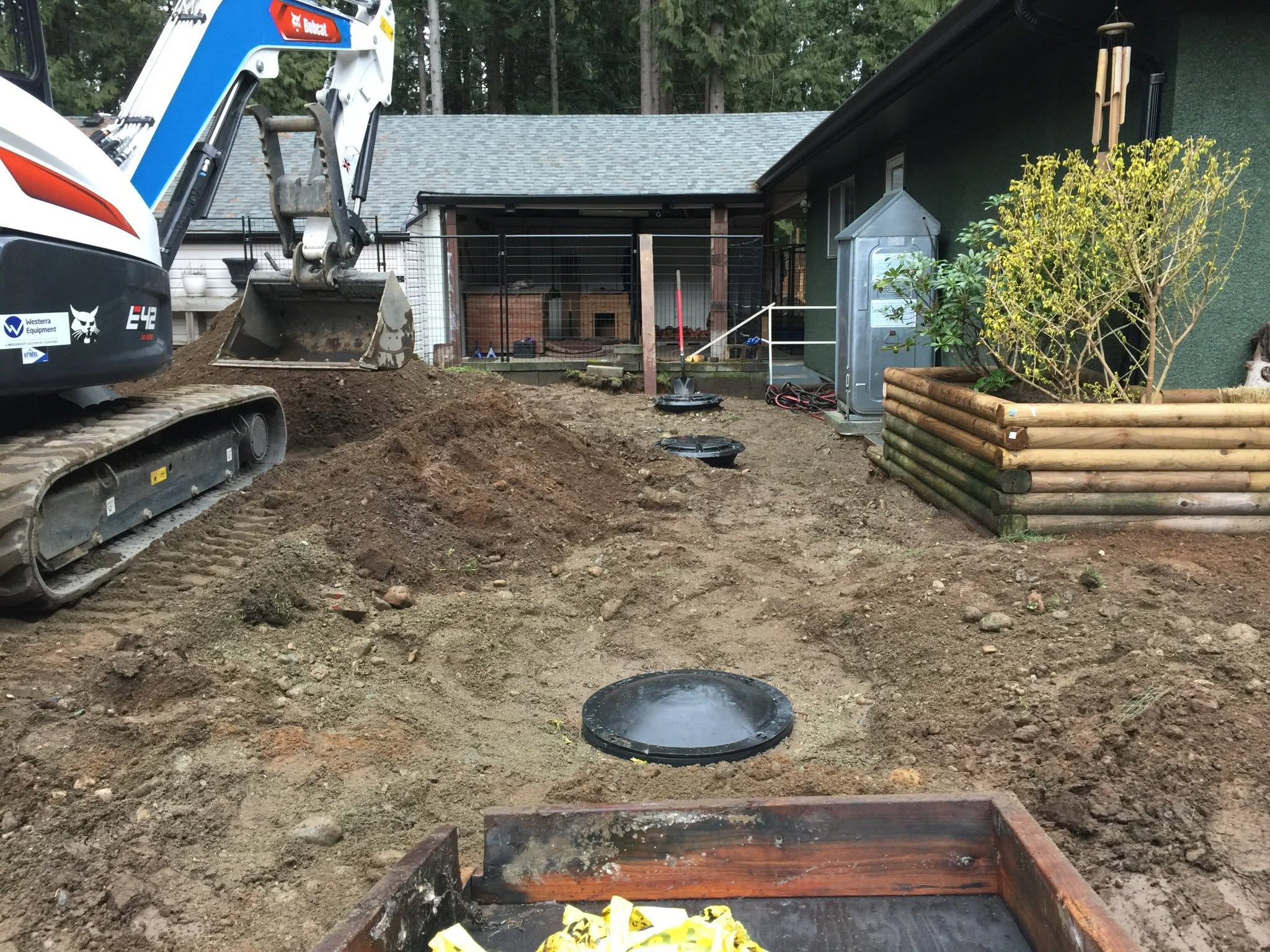
A lot that a Bobcat or excavator can reach easily, with room to maneuver and no major obstacles, keeps excavation costs down. A lot with tight access, mature trees close to the work area, a steep slope, or a long distance between the road and the install site adds time and sometimes requires smaller, less efficient equipment, both of which raise the price.
This is one of the reasons a site visit before quoting matters so much. A phone estimate cannot account for how hard the equipment has to work to actually get the job done.
What Can Make a Project More Expensive Than Expected
A few things catch homeowners off guard if they were not part of the original budget conversation. Rock encountered during excavation that was not visible at the surface can add cost partway through a project. A drain field that needs to be significantly larger than expected because of poor percolation results changes the scope after design is already underway. And any need to import fill for a raised or mound system adds material and trucking costs that a straightforward in-ground system would not carry.
A thorough site assessment before design reduces the odds of these surprises, but Island soil can be genuinely unpredictable, and building a bit of contingency into your budget is a reasonable move on any septic project.
Ways to Keep Costs Reasonable Without Cutting Corners
Getting multiple quotes from contractors who have actually done a site visit, rather than comparing phone estimates, gives you a real basis for comparison. Being upfront about your full intended household size and any planned additions helps the design account for future needs instead of requiring a redo later. And timing the work for the dry season, when the ground is stable and easy to work, keeps excavation efficient and avoids the added cost of working saturated soil.
None of these change what the site fundamentally requires, but they help make sure you are paying for the system you actually need and not for avoidable complications.
Common Questions About Septic Installation Cost
What is the average cost of a septic system on Vancouver Island?
Most conventional systems land somewhere between fifteen and thirty thousand dollars including design and permitting, though engineered systems on more difficult sites can run higher. An accurate number only comes from a site assessment.
Why do some septic systems cost so much more than others?
Soil conditions, site access, and whether the property needs an engineered system rather than a conventional one are the biggest factors. Two homes the same size can have very different septic costs depending entirely on what is in the ground.
Do I need a permit to install a new septic system in BC?
Yes, every new system requires a permit through Island Health, and the design has to come from a registered onsite wastewater practitioner. This is not something that can be done informally.
Can I reduce cost by installing the system myself?
Design and installation both require licensed and registered professionals under BC regulations, so a DIY approach is not a realistic way to cut cost on a new system. Where homeowners can save is in getting multiple quotes and planning the project for efficient timing.
How long does a new septic installation take from start to finish?
Between the site assessment, design, permitting, and construction, a new system typically takes a few weeks to a couple of months depending on the jurisdiction’s permit turnaround and the complexity of the design. Simpler conventional systems on straightforward sites move faster than engineered installs.
Is a raised or mound system always more expensive than a conventional one?
Generally yes, since it requires imported fill, additional design work, and often a pump station. It becomes necessary specifically on sites where a conventional system will not work, so the added cost reflects what the site requires rather than a choice made for its own sake.
Get an Accurate Number for Your Property
The only real way to know what a septic system will cost on your Vancouver Island property is to have someone walk the site, look at the soil, and understand what the home actually needs. Anything else is a guess dressed up as a number.
Vireel handles septic design coordination, excavation, and installation across Nanaimo and Central Vancouver Island, and can walk your property with you to give you a realistic picture before you commit to a budget. Reach out at vireel.ca to get started.