

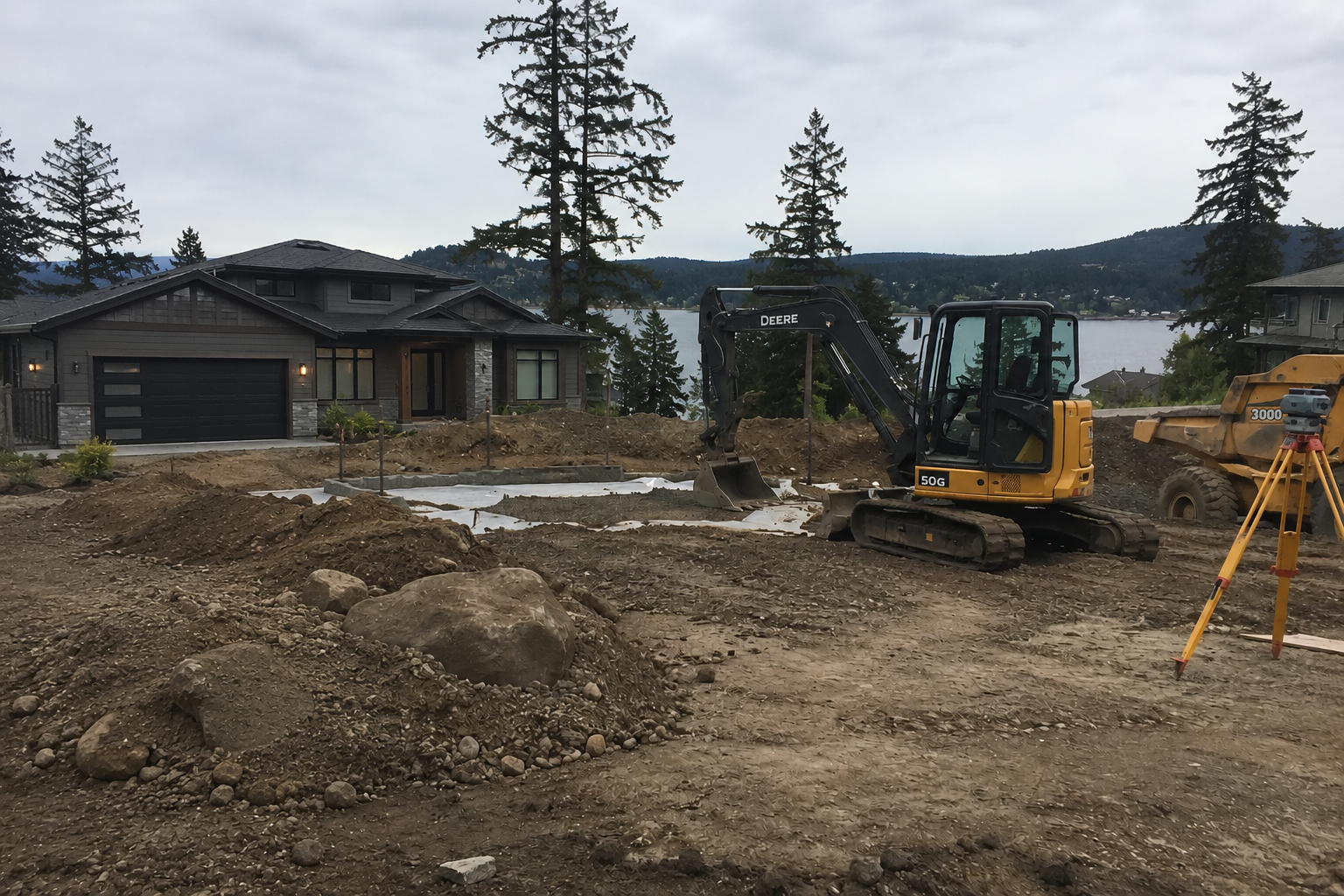
Most homeowners planning a driveway, a septic install, a foundation, or a drainage fix do not think much about permits and utility locates until someone asks them whether they have one. Getting this sorted before the excavator shows up saves real time and avoids the kind of delay that turns a two-day job into a two-week one.
Do you actually need a permit?
It depends on the municipality and the nature of the work. Some excavation projects, particularly those tied to septic systems, building foundations, or work near watercourses, require permits from the local jurisdiction or from Island Health in the case of septic. Smaller landscaping digs on private property away from services or waterways often do not. Because requirements vary between the regional districts and municipalities across the Island, this is worth confirming with your local building department before assuming either way.
A good rule of thumb: if the project involves a septic system, a structure, grading that changes drainage patterns, or anything near a stream or wetland, assume a permit is likely required and check early. Permit turnaround can take anywhere from a few days to several weeks depending on the jurisdiction and the project, so building that time into your schedule matters.
Utility locates: the step nobody skips twice
Before any excavation work begins, underground utilities need to be located and marked. This includes BC Hydro power lines, gas lines, telecom cable, water, and sewer. A free public locate request through BC 1 Call covers the utilities that run to the property line. Private utility lines on the property itself—from the meter to the house, or a septic system’s own piping—are the homeowner’s responsibility to identify, often through old property records, a septic as-built diagram if one exists, or a private locate service.
Skipping this step is how a routine dig turns into an emergency repair bill, or worse, a safety incident. It is also, in many cases, a legal requirement before excavation, not just a good idea.
Site access and staging
Before equipment arrives, it helps to walk the site and think through a few practical questions. Can a Bobcat or excavator actually reach the work area, or does something need to be moved—fencing sections, garden beds, a parked vehicle? Where will excavated material be staged if it is being reused for backfill, and where will it go if it is being hauled away? Is there a clear path in and out that will not tear up an existing lawn or driveway unnecessarily?
None of this needs to be figured out alone. A contractor doing a site visit before the work starts will usually flag access issues and staging needs as part of the quote, which is one reason an in-person assessment tends to catch problems a phone estimate would miss.
Soil and drainage considerations specific to the Island
Central Vancouver Island soil varies a lot from property to property, from well-draining sandy loam to dense clay that holds water and complicates both septic installs and general grading work. A proper site assessment, sometimes including a percolation test for septic-related projects, tells you what you are actually working with before equipment moves any dirt. Skipping this step on a septic-related excavation in particular can mean a system installed that does not perform the way it should, which is a far more expensive fix after the fact than testing beforehand.
Weather and timing
Excavation on the Island slows down or stops in sustained wet weather, not because the equipment cannot handle mud, but because working saturated soil compacts it poorly and can damage the site for whatever comes after—a driveway base, a septic field, a foundation footing. Late spring through early fall tends to offer the most consistent working conditions, though a dry stretch in any season can open a window. Planning excavation work with some flexibility in the schedule, rather than a fixed date, tends to produce a better result.
Cost factors that a permit and locate process can affect
Permit fees and any required engineering reports, which some jurisdictions require for larger excavation or septic-related projects, add a cost that is easy to overlook when budgeting for the visible excavation work itself. Utility locates through BC 1 Call are free for public utilities, but a private locate service for septic or irrigation lines not covered by the public process carries its own cost, generally modest compared to the excavation work itself but worth factoring in. Delays from permit turnaround or a locate that turns up an unexpected utility conflict can also push a project’s timeline out, which indirectly affects cost if it means rescheduling equipment or crew availability.
What a straightforward excavation project timeline looks like
- Site visit and quote, including access, staging, and rough scope
- Permit application if required, and utility locate request through BC 1 Call
- Confirmation of private utility and septic locations if applicable
- Scheduling around weather and equipment availability
- Excavation and grading work
- Backfill, compaction, and site cleanup
What a contractor’s site visit should cover
A proper pre-excavation site visit goes beyond just eyeballing where the digging happens. It should include a look at existing grade and drainage patterns, since changing how water moves across a property can create problems for neighbouring lots if not planned carefully. It should also cover soil type where visible, access routes for equipment, and any obvious obstacles—mature trees with root systems in the work area, retaining walls, fencing, or existing hardscaping nearby. For septic-related excavation specifically, the site visit should also confirm setback distances from wells, watercourses, and property lines, which are regulated distances under Island Health requirements and are not optional to work around.
Homeowners sometimes assume a site visit is just a formality before the quote gets written. In practice, it is where most of the problems that would otherwise show up mid-project get caught in advance, while they are still cheap to plan around.
Working around existing landscaping and structures
Excavation rarely happens on a blank slate. Established gardens, mature trees, fencing, and irrigation lines all factor into how a project gets planned and executed. Root systems from mature trees near a planned dig site can extend well beyond the visible canopy, which matters both for protecting the tree’s health and for the excavation crew planning around unexpected root mass. Existing irrigation or drainage lines that are not part of the formal utility locate, since they are private lines rather than public utilities, need to be identified by the homeowner or through property records before work begins, the same way private septic lines do.
Frequently asked questions
How long does a BC 1 Call locate take? Typically a few business days, though it can vary. Requesting it as early as possible in the planning process avoids it becoming the bottleneck on your project timeline.
Who is responsible for locating a septic system before digging nearby? The homeowner or their contractor, using property records, an as-built diagram if one exists, or a private locate if records are unclear. Public utility locates do not cover septic systems.
Can excavation happen in winter on Vancouver Island? It can, but wet conditions make it harder to get a clean result, particularly for anything involving compaction or drainage. A dry-weather window is generally preferable when the project allows for flexibility.
Do I need a permit for a simple grading or drainage project? It depends on the scope and your local jurisdiction. Work that changes how water moves across a property, especially near a neighbouring lot or a watercourse, is more likely to require review than a small, contained landscaping dig.
What happens if an unmarked utility is hit during excavation? This is exactly what the locate process is designed to prevent, and it is why skipping it carries real risk—both a safety risk and a financial one, since repair costs and potential fines for damaging an unmarked utility typically fall on whoever was digging without a proper locate in place.
Can excavation work affect my neighbour’s property? It can, particularly with grading or drainage changes, which is another reason a proper site assessment matters. In some cases, work near a shared property line may require notifying or coordinating with a neighbour, depending on the scope and local bylaws.
If you are planning excavation work and are not sure what permits or locates apply to your project, Vireel can walk the site with you and help sort out what needs to happen before the equipment shows up.