

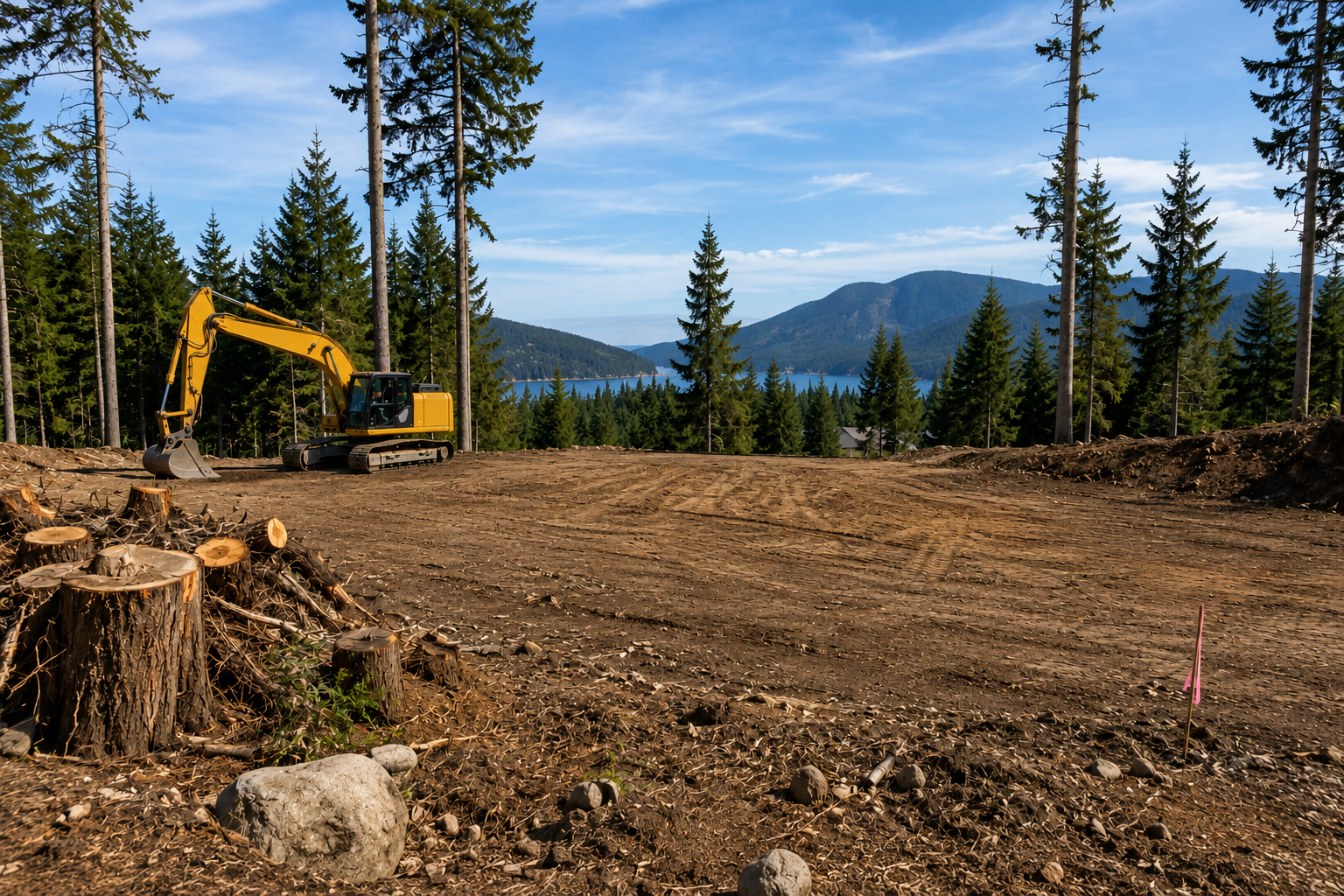
Before a foundation, a driveway, or a septic field goes in, the land underneath it needs to be prepared properly, and on a forested Island lot, that is rarely as simple as knocking down a few trees. Land clearing and grading set the stage for everything that follows, and getting it wrong creates problems that show up years later as drainage issues, foundation settling, or a driveway that erodes every wet season.
Clearing: more than just removing trees
Clearing a lot involves removing trees, stumps, brush, and any existing debris from the building envelope and the access route equipment will need. On the Island, this usually means dealing with root systems from mature conifers, which extend well beyond what is visible above ground and can interfere with foundation work or utility trenching if not fully removed from the relevant area. Stumps in particular need to be grubbed out, not just cut off at grade, since a buried stump left in place will eventually decompose and create a void underground that can cause settling issues under a driveway, patio, or even a foundation edge if it was close enough.
Clearing decisions also need to account for which trees, if any, are being retained. Protecting a specific tree’s root zone during nearby excavation work is possible but requires planning before equipment starts moving, since root damage from heavy equipment traffic or grade changes near the root zone can kill a tree slowly over subsequent seasons even if it looks fine immediately after construction.
Grading: shaping the land to manage water
Once a site is cleared, grading shapes the land to the elevations the project actually needs, including level building pads, sloped driveways, and critically, drainage patterns that move water away from structures rather than toward them. This is one of the most consequential parts of site prep and one of the easiest to get wrong without proper planning, since water that is not directed away from a foundation during grading will find its way there eventually, often showing up as a wet crawlspace or basement years after construction rather than an immediate problem.
Proper grading typically slopes the ground away from the foundation for a meaningful distance, several feet at minimum, before any downward slope elsewhere on the property is allowed to take over. Getting this detail right during initial grading avoids expensive corrective drainage work down the line.
Soil conditions across Vancouver Island properties
Central Vancouver Island soil varies significantly from lot to lot, featuring sandy, well-draining soil in some areas, dense clay in others, and rocky terrain in still others requiring different equipment and techniques altogether. A soil assessment early in the planning process, sometimes including test pits or a percolation test if a septic system is also part of the project, tells you what the land can actually support before design decisions are finalized around an assumption that may not hold for your specific lot.
Access and staging for equipment on a forested lot
Many Island building lots do not have an existing driveway or clear access route, which means part of the clearing project involves creating a temporary or permanent access path sturdy enough for excavation and construction equipment. This needs planning around existing grade, wet areas, and any trees being retained along the route, and is often one of the first practical decisions made on a new build, since equipment needs to reach the site before any other work can start.
Debris management: what happens to everything that gets cleared
Cleared material, such as trees, stumps, and brush, needs a disposal plan. Options generally include chipping suitable material on site for reuse as mulch, burning where local bylaws and burn permits allow, which varies by jurisdiction and season on the Island, or hauling debris off site entirely. Burning restrictions in particular are worth checking early, since many Island municipalities and regional districts restrict or ban open burning during the drier months, which can affect project timing if burning was part of the original debris plan.
Erosion control during the clearing and grading window
Between the time land is cleared and the time permanent landscaping or hardscaping is established, exposed soil is vulnerable to erosion, particularly during Vancouver Island’s wet season. Temporary measures like silt fencing, straw wattles, or simply timing major clearing and grading work for a drier stretch of the year where possible, help prevent topsoil loss and reduce sediment runoff affecting neighbouring properties or nearby watercourses. Some jurisdictions require erosion and sediment control plans as part of the permitting process for larger clearing projects, particularly near sensitive areas, so this is worth checking early rather than treating it as an afterthought once work is already underway.
Working with a contractor who understands sequencing
Land clearing and grading rarely happen in isolation. The sequence in which clearing, utility trenching, grading, and any septic or foundation work occurs affects the whole project’s efficiency and cost. Grading before utilities are roughed in, for example, sometimes means regrading later once trenches are backfilled, adding cost that proper sequencing would have avoided. An experienced excavation contractor plans this sequence with the full project in mind rather than treating each phase as an isolated task, which is part of what a thorough initial site visit and project discussion should cover before work begins.
Wildlife and environmental considerations
Vancouver Island properties, particularly larger rural lots, sometimes border sensitive habitat, wetlands, streams, or areas with known wildlife activity that affects what clearing work is permitted and when. Some jurisdictions restrict clearing during specific seasons to protect nesting birds or other wildlife, and any work near a watercourse typically triggers additional setback requirements and possibly a separate environmental review. Checking these considerations during the initial planning stage, rather than after a permit application is already submitted, avoids delays that can otherwise push a project’s timeline out significantly.
A realistic sequence for a new build site
- Site assessment: analyzing soil type, drainage patterns, trees to retain, and the equipment access route
- Permits and utility locates as required for the specific project
- Clearing: removing trees, stumps, and brush, with dedicated root zone protection for retained trees
- Debris management: chipping, burning if permitted, or hauling off site
- Rough grading: shaping the site to planned elevations and drainage patterns
- Final grading once other site work, including the foundation, septic system, and driveway, is complete
Frequently asked questions
How much does land clearing typically cost on Vancouver Island?
It varies enormously based on lot size, tree density, terrain, and access difficulty. A site visit is really the only way to get an accurate estimate, since a heavily forested, sloped lot costs meaningfully more to clear than an open, flat one of the same size.
Can I keep some trees on my lot during clearing?
Yes, with planning. Identifying which trees to retain before clearing starts, and protecting their root zones from equipment traffic and grade changes during the project, is the key to keeping them healthy afterward rather than losing them slowly over the following seasons.
Do I need a permit to clear land on my own property?
It depends on the jurisdiction, the size of the area being cleared, and whether the property is near a watercourse or has other environmental considerations. Checking with your local building department before starting is worth doing, particularly for larger clearing projects.
How does grading affect where I can put a septic field later?
Grading and septic field placement are closely linked, since the field depends on proper drainage and soil conditions that grading choices directly affect. Planning both together, rather than grading first and figuring out septic placement afterward, generally produces a better result.
How long does land clearing and grading typically take?
It depends heavily on lot size, tree density, and terrain, ranging from a few days for a smaller, lighter lot to several weeks for a heavily forested or challenging site. A site visit gives a much more accurate timeline estimate than a general rule of thumb.
What happens if unexpected rock or poor soil is discovered mid-clearing?
This does happen on some Island lots, and it typically means adjusting the equipment approach or, in some cases, revisiting the project’s grading plan. This is one more reason an experienced contractor and a proper initial site assessment matter, since it reduces the chance of a major surprise partway through, though rock and unusual soil conditions can sometimes only be fully confirmed once excavation is underway.
If you are planning a new build or addition and need land cleared and graded properly from the start, Vireel can walk the site with you and put together a realistic plan before any equipment moves.